paintings
-

Time and Tide
1945 — 1946The paintings in Time and Tide — The Story in Pictures of Roebuck Bay N.W Australia Elizabeth Durack's first exhibition, were produced over an eight month period (October 1945—May 1946) when the artist was based in Broome, Western Australia. In some 100 works she created paintings from direct observation, imagination and research that reflect the pearling town's past and present.
Later she recalled: " ... the war was ended. A tiny town, along with great cities and vast tracts of land, lay in waste. It had been bombed, evacuated and neglected, yet there — in that remote corner of the ... -
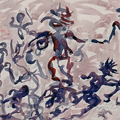
Prelude
1947 - 1950Prelude is the title of one of many watercolours produced between the years 1947–1950. The word refers also to a large number of paintings created when Elizabeth Durack, then in her early thirties, was honing her talent and setting a course for the future. The well-spring of the Prelude works is the artist's experience of northern Australia. Its dominant theme — the interdependence of human beings and land.
Inspired since childhood by the Kimberley region of north western Australia — where Durack had privileged access through long family association — and based after the war on remote Ivanhoe cattle station (where ... -
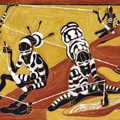
The Cord to Alcheringa
1953The Cord to Alcheringa was the first of four major series inspired by Aboriginal ritual and legend. It was followed by The Chant for Kurdaitcha (1954), Love Magic (1954) and The Legend of the Black Swan (1956).
All four series reflect an affinity with an Aboriginal view of the world that is incorporated within Elizabeth Durack's own perceptions and distinctive style.
The paintings stem partly from personal experience of ceremonies, from familiarity with ancient masterpieces on rock faces in ... -
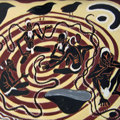
Chant for Kurdaitcha
1954Chant for Kurdaitcha was the second of four series inspired by Aboriginal ritual and legend. It followed The Cord to Altcheringa (1953) and appeared shortly before Love Magic. In 1956 the artist produced the last of the set: ten large panels depicting The Legend of the Black Swan.
All four series reflect Elizabeth Durack’s affinity with an Aboriginal view of the world. Using a limited palette of ochre colours she created works, striking in drama and design, that combined an essence of Aboriginality ... -
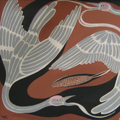
Love Magic
late 1954Love Magic was the third of four series inspired by Aboriginal ritual and legend. It followed The Cord to Altcheringa (1953) and Chant for Kurdaitcha. In 1956 the artist produced the last of the set: ten large panels depicting The Legend of the Black Swan.
All four series reflect Elizabeth Durack’s affinity with an Aboriginal view of the world. Using a limited palette of ochre colours she created works, striking in drama and design, that combined an essence of Aboriginality within her own perceptions ... -

The Legend of the Black Swan
1956The Legend of the Black Swan depicted on ten large panels in 1956, was the fourth in a series directly inspired by Aboriginal art and legend. The story itself was recounted by the Euahlayi people of New South Wales to K. Langloh Parker towards the end of the 19th century and first published as Australian Legendary Tales in London in 1896, republished by Angus & Robertson, Sydney, in 1953. The Durack panels were originally displayed on pillars within the staff dining room of the Sir Charles Gairdner Hospital, Perth and later transferred to walls near the main reception area ...
-
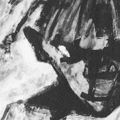
Eastern Goldfields
late 1950s — early 1960sApplicable to the Eastern Goldfields paintings are extracts from disparate sources below:
Essentially and in the final analysis, pictures exist in their own right, through and by reason of their own vitality and according to a set of laws, beyond, I believe, full explanation. The pictures that are living today and that have passed into the fabric of our minds do so of their own power, speaking through the confusion of words elucidating them, and in spite of, not because of, the “explanations” by some thought necessary. Words become a prop that is leant on heavily to see back into the picture that which is already there ...
-
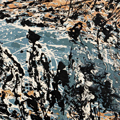
Melted Images
1961 — 1964The ‘melted image’ or tachiste paintings by Elizabeth Durack are a continuation and development of the theme in which human beings and the environment interact — ‘a deeper and harder (though always compassionate) way of looking at man and nature ...’.
Randolph Stow, Comment in catalogue essay, September 1961
The works ‘fuse linear outlines with fluid hydraulic forms of floating colour to produce controlled Rorschachs ... their emotional impact is considerable. They make an important contribution to the solution of the Australian landscape problem ... The human being is in these paintings, as he is in Australia, almost by accident. But once in, he is in to ... -

Singapore, Hong Kong, Manila
1967 to 1973'Living and learning' were guiding principles for Elizabeth Durack; her interest in many subjects and cultures persistent and life–long. Some 40 years before the phenomenal rise of international tourism and luxury package tours she travelled widely through five continents visiting great cities and tiny out–of–the-way places making notes, walking and drawing constantly and frequently using local transport. She claimed, at one stage: 'There's nothing like comfort to dull the senses ...'
This series depicts three major East Asian centres — Hong Kong, Manila and Singapore. All date from the 1960s and early 70s. (Mainland China had not yet opened to the West.) Within the series a ... -

Battle Cries
1978Battle Cries, a series of almost 30 works is passionate and sardonic response to another war ... to the turmoil and distortion, the agony and courage, the construction and destruction, the reconstruction and deconstruction associated with war wherever it occurs in the world.
For such timeless subject matter, Durack found within abstraction a freedom to convey insights into modern warfare — insights that are highlighted by terse, ambiguous titles, a number of them famous lines from ... -
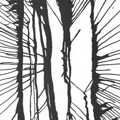
'. . . black swan of trespass on alien waters'
1979… black swan of trespass on alien waters is a suite of 15 paintings named for some well-known explorers and discoverers of Western Australia.
The title is a line from an Ern Malley poem:
Durer: Innsbruck, 1495
… I had read in books that art is not easy
But no one warned that the mind repeats
In its ignorance the vision of others. I am still -
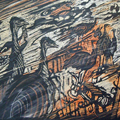
Flightless birds achieve lift-off ...
1975Flightless Birds Achieve Lift-off … a suite of 10 paintings, is closely related in style and sentiment to the large body of work The Rim, the rim of our brittle and disintegrating world … (refer next series).
The emus — uniquely Australian flightless birds — are symbolic here of seasonal and also of political fluctuations. After several good seasons in the early 1970s emu numbers, and likewise their confidence, had increased to such an extent they were encroaching upon areas where they were out of control and forced to confront the reality of their inbuilt limitations. ... -
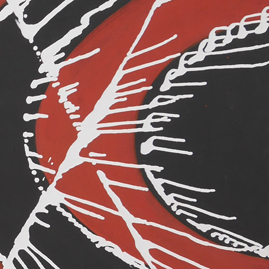
Fallout from Botany Bay
1988Fallout from Botany Bay is a series of 10 paintings inspired by Australia's Bicentennial Celebrations in ...
-
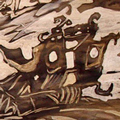
The rim of our brittle and disintegrating world...
1970s — 1990s, a continuumThe Rim, the rim of our brittle and disintegrating world … together with the sequence The Rim and beyond … is pivotal to the art of Elizabeth Durack. A continuum of work from the imaginative 'out of mind' stream, (as distinct from the graphic 'out of sight' stream), The Rim … bridges all that came before and all that came after.
Years before the degradation in Australia’s remote communities was publicly confronted and acknowledged Rim ... paintings reflected the reality of misguided, if well-intentioned, officially sanctioned policies.
Rim ... paintings emerged — or ... -
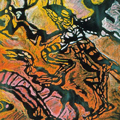
The Art of Eddie Burrup
1940s — 2000, a continuumThe extensive body of work, visual and written, created between the years 1994 and 2000 that comprises The Art of Eddie Burrup is the final phase in the evolution of Elizabeth Durack’s oeuvre. In spirit and purpose it aligns with all that came before; it can be traced back some 60 years. It was nascent in the 1930s and probably first emerged in recorded visual form via The Whirlwind drawings and paintings of 1940–41. Towards the end of her life — through her daemon, Eddie Burrup — Elizabeth Durack distilled a lifetime of living and learning, of giving ...